Press Release: The Occupied City
The Occupied City: New York and the American Revolution
Opens on May 1, 2026
Press Preview: Tuesday, April 28, 2026, 10:00 a.m. to noon.
NEW YORK, NY (Spring 2026) — On the occasion of the 250th anniversary of the American Revolutionary War, the Museum of the City of New York (MCNY) and Gotham Center for New York City History at The Graduate Center, City University of New York will present The Occupied City: New York and the American Revolution, a new exhibition opening on May 1, 2026.
This 7,000-square-foot exhibition will take over MCNY’s entire third floor for a year, offering an immersive exploration of the city’s pivotal role during the Revolutionary War. Visitors will encounter New York from the era of the Imperial Crisis in 1763 through its emergence as the nation’s first capital in 1790, experiencing the Revolution as it unfolded across a complex and divided city.
A crucial strategic site for both the Patriots and the British, New York City played an instrumental role in the founding of the United States. The Occupied City reveals how the city’s diverse population—from revolutionaries and loyalists to enslaved and free Black New Yorkers and Native peoples—shaped the events that gave rise to a new nation. It highlights both the city’s strategic importance and the profound challenges faced by its residents during British occupation, as well as their resilience in the face of upheaval.
Stephanie Hill Wilchfort, Ronay Menschel Director and President of MCNY, remarked, “This exhibition provides an extraordinary lens through which to explore the complexities of New York City’s role in the American Revolution, and a powerful opportunity to reflect on how American identity was formed and how these historical legacies continue to impact our city and country today.”
Exhibition Highlights
Through a dynamic mix of historical objects, interactive media, and immersive environments, the exhibition transports visitors into Revolutionary-era New York. Across these environments, objects from MCNY’s collection play a central role, shaping both the visual experience and the exhibition’s historical interpretation.
In a recreated tavern, the Museum’s decorative arts holdings are fully integrated into the setting, with original seventeenth- and early eighteenth-century jugs, bottles, drinking vessels, and tableware—including a “flip” glass, flagons, plates, and canns—arranged on open shelving as a cohesive ensemble. Rather than being presented as isolated highlights, these objects function as part of a lived-in environment, immersing visitors in the material culture of everyday social and political life.
Similarly, in a coffeehouse environment, objects from the Museum’s collection furnish and animate the space. A five-legged gaming table and period seating are paired with a silver coffee service—coffeepot, sugar dish, teaspoons, and porcelain cups and saucers—displayed as if in use. These are complemented by a portrait of King George III and a loaned “No Stamp Act” teapot, situating the environment within the political tensions of the era and illustrating how spaces of sociability were also sites of debate and dissent.
A vignette devoted to Alexander Hamilton anchors the exhibition in the life of a key historical figure. Hamilton’s desk and armchair, drawn from MCNY’s collection, are presented alongside personal artifacts including a marble bust, a miniature portrait, and even a preserved section of a tree he planted, as well as a portrait of Elizabeth Schuyler Hamilton. Together, these objects create a layered, biographical setting that connects visitors directly to Hamilton’s personal and professional world.
Additional highlights include a rarely seen volume of the “Inspection Roll of Negroes” (“Book of Negroes”) on loan from the National Archives—one of only two known copies—presented alongside an interactive that brings its recorded names to life. The exhibition also features immersive experiences such as “Canvas Town,” a refuge for displaced New Yorkers, and multimedia installations that dramatize key events including the Battle of New York and the toppling of the statue of King George III at Bowling Green. Through projected videos, visitors will discover a recreation of New York City in the Revolutionary Era through scenes drawn from Assassin’s Creed III, the fifth major installment in the Assassin’s Creed video game series, set in 18th-century America.
Sarah Henry, Senior Scholar and Curator Emerita of the Museum of the City of New York, added, “By shedding light on the diverse people who lived in New York City during the American Revolutionary War, we gain a deeper understanding of how their struggles, decisions, and sacrifices shaped the course of history.”
The exhibition also builds on the Gotham Center’s Revolutionary NYC digital walking tour, now available as a mobile app, offering visitors additional context and opportunities to explore the city’s Revolutionary history beyond the gallery.
Peter-Christian Aigner, Co-Founder of NYC Revolutionary Trail and Director of the Gotham Center for New York City History at The Graduate Center, City University of New York, shared, “This exhibition is deeply rooted in new scholarship and research that unearths stories previously left out of traditional narratives. We are excited to bring these critical histories to the public, giving a fuller picture of the experiences of everyday New Yorkers during the Revolution.”
Programs
Inspired by and presented in conjunction with The Occupied City: New York and the American Revolution, opening May 1, 2026, the Museum of the City of New York (MCNY) announces Revolutionary New York: Then and Now, a new six-part public program series examining how the American Revolution continues to shape New York City and the nation today.
Extending the themes of the exhibition, Revolutionary New York: Then and Now is moderated by MS NOW Emmy- and Peabody Award–winning journalist Antonia Hylton. The series brings together leading historians, public thinkers, and cultural leaders to explore the Revolution as both a historical event and an ongoing civic project—examining its impact on colonial-era New Yorkers, its role in shaping the city, and its continued relevance today.
Please find details on upcoming programs inspired by The Occupied City below:
Fashion of the Founding Fathers: George Washington
Thursday, May 7, 2026, 6:30 p.m.
A Divided City: Revolutionary-Era New York and the Politics of Polarization
Friday, May 15, 2026, 6:30 p.m.
Revolution Remembered, Stories Forgotten
Tuesday, June 23, 2026, 6:30 p.m.
The Occupied City: New York and the American Revolution is made possible by presenting partners, the Andrew Carnegie Foundation, an Anonymous Family Foundation, Kenneth C. Griffin and Griffin Catalyst, and The Hearthland Foundation.
Special thanks to our benefactors, Elizabeth K. Belfer, Matt and Marisa Brown, The National Endowment for the Humanities: Democracy demands wisdom, New York City Department of Cultural Affairs in partnership with the City Council, and The Robert David Lion Gardiner Foundation.
Additional support provided by advocates, The Achelis and Bodman Foundation, Chris Brown, Stavros Niarchos Foundation (SNF), Heather and William Vrattos. Thank you to sponsors, Daryl B. Uber and New York State Council on the Arts; and friends, Matthew Breitenbach and Terry Schwartz Breitenbach, The Blanche and Irving Laurie Foundation, and Peck Stacpoole Foundation.
Curatorial and collections work on this exhibition is provided by the Laura and Ray Johnson Fund and Robert A. and Elizabeth R. Jeffe.

Any views, findings, conclusions, or recommendations expressed in this exhibition do not necessarily represent those of the National Endowment for the Humanities.
About the Museum of the City of New York
The Museum of the City of New York celebrates and interprets the city’s history, art, popular culture, and civic life, highlighting New York’s influence worldwide. Founded in 1923 as a private, nonprofit corporation, the Museum serves 200,000 visitors from around the world through exhibitions, school and public programs, publications, and collections.
For media inquiries, please contact the Museum’s Press Office via pressoffice@mcny.org, or by phone at 917.492.3482.
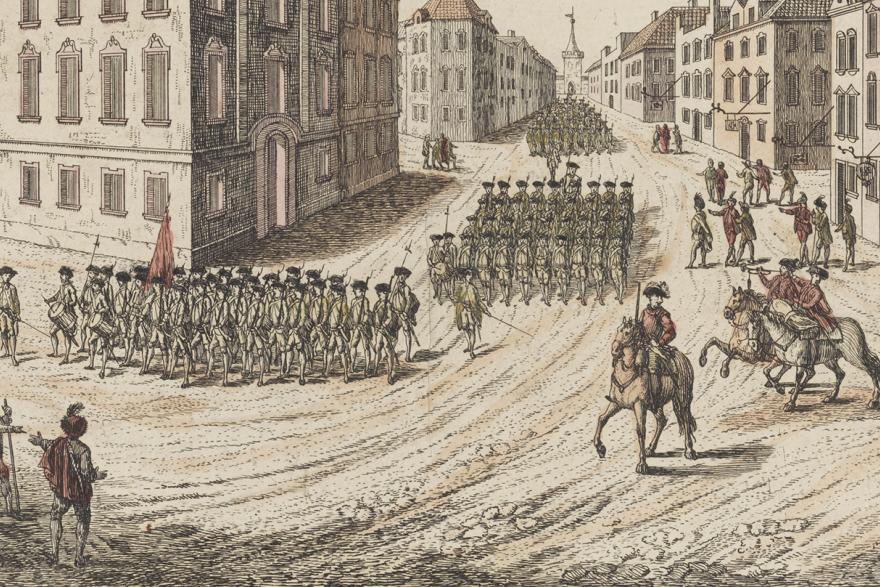
Image: Franz Xaver Habermann (1721-1796), The Triumphal Entry of Royal Troops into New York. ( L'Entré Triumphale de Troupes Royales a Nouvelle Yorck). Print. Collection of the Museum of the City of New York. 29.100.2024