Press Release: Halumii Ktapihna
Museum of the City of New York to Open Halumii Ktapihna: Lenape Legacies and Futures
Press Preview: Tuesday, September 22 | Public Opening: Friday, September 25
Contact: PressOffice@mcny.org | 917.492.3482
NEW YORK, NY (July 23, 2026) — The Museum of the City of New York (MCNY) today unveiled plans for Halumii Ktapihna: Lenape Legacies and Futures, opening to the public on Friday, September 25, with a press preview on Tuesday, September 22.
Created in collaboration with the Éenda-Lŭnaapeewáhkiing Collective — a group of Lunaapeew community members from the United States and Canada, the exhibition explores contemporary Lunaapeew culture by bringing together the work of more than 30 artists alongside objects and archival materials. Highlights include paintings, prints, photography, tools, and textiles, and ceremonial garments — all made by Lunaapeew artists, with videos and interactives introducing visitors to individuals and language.
Stephanie Hill Wilchfort, Ronay Menschel Director and President, Museum of the City of New York: "In Halumii Ktapihna, the Lunaapeew story isn't behind glass in the past tense. It's being made right now, by more than thirty living artists, and it belongs here, in the city that is the Lunaapeew homeland."
“Our communities have said for generations: we are still here,” said Brent Stonefish, Curatorial Advisor, and founding member of the Éenda-Lŭnaapeewáhkiing Collective. “This exhibition gives that truth a home in one of New York’s own museums. It was important to us that the work be led by Lunaapeew people, so that what visitors encounter is not a history lesson about us, but a reflection of who we are today, and who we are becoming.”
“So much of what people think they know about the Lunaapeew stops at the 1600s,” said Cory Ridgeway, Curatorial Advisor, member of the Éenda-Lŭnaapeewáhkiing Collective, and member of the Nanticoke Indian Tribe of Delaware. “Halumii Ktapihna was built to correct that, to show that we are still here, still making, still passing down what our elders gave us. Being part of this exhibition and seeing our communities represented at a museum in the middle of Lenapehoking, matters more than words can really capture.”
“This exhibition is a chance to shine new light on a story New York has told about itself for four hundred years,” said Angel “Monxo” López, Curator of Community Histories, Museum of the City of New York. “The Lunaapeew never left this land, and their history did not end. Halumii Ktapihna brings together artists, elders, and knowledge-keepers to show a living culture, one that is still shaping its own future, right here in New York City.”
The Lunaapeew Today
At the exhibition’s entrance, visitors meet the Lunaapeew through three short videos paired with everyday belongings: a nineteenth-century clay pipe from the Ramapough Munsee Lunaape Nation, a pair of child’s moccasins made in 2026 by Cory Ridgeway, and a replica Munsee-Delaware treaty belt woven in wampum by Kristin Jacobs.
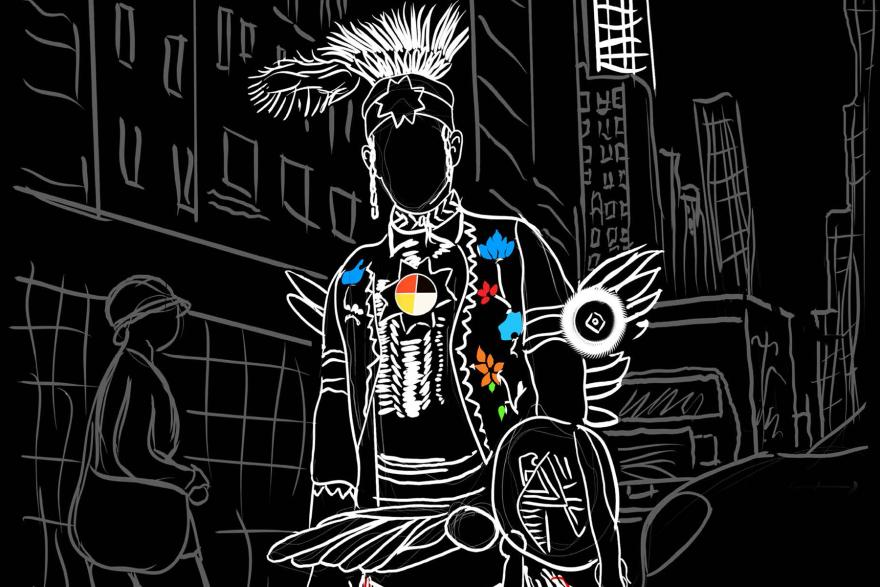
Nearby, two maps help anchor this part of the gallery: one tracing the original Lunaapeew sites and trails across the region, alongside the paths of forced removal that scattered communities across the continent; the other showing where Lunaapeew nations live today, from Wisconsin to Oklahoma to Ontario. Elsewhere in this section, Holly Wilson’s cast bronze sculpture Bloodline, Portrait of Community and a self-portrait by Jack Crying Raven Anderson speak to individual identity within a shared inheritance. A print by June Lee Van Dunk places an individual dressed in Indigenous regalia set against a backdrop that includes the Empire State Building, while a work by Vanessa Dion Fletcher uses quill work in a contemporary, abstract fashion.
A listening station invites visitors to pick up a receiver and hear Lunaapeew music spanning six decades, from field recordings made in the 1960s to songs released in the past few years, including tracks from the Red Blanket Singers and musician Brock Stonefish.
Homelands
The second section of the gallery examines how Lunaapeew relationships to the lands and waters of Lunaapeewáhkiing shape tribal governance, collective responsibilities, and ongoing struggles to protect the environment and sacred places.
A 1920 photograph of a Native rock dwelling near Cold Spring hangs in this part of the exhibition. Nearby, protest banners reading “Save our Earth” and “Save our land, save our sacred sites,” made by Lunaapeew artists, hang alongside work like Denise Bright Dove Ashton-Dunkley’s “Dragonfly Essence” purse and “Earthbound Luxe” sneakers, which fold fish leather and gold foil into wearable art, a reminder that stewardship of the land is an ongoing practice.
Two seventeenth-century land deeds, one from 1687 and one from 1696, inked between Lenape and Unkechaug sachems and English colonists, sit near a single piece of wood saved from the “Treaty Oak” felled in the 1930s, and a photograph of the tree that once stood in its place, speaking to a history that resists easy resolution. Nearby, a 1639 reproduction of the Manatus Map, one of the earliest European renderings of the region, hangs near a silver seal from the 1964 World’s Fair, two documents, made three centuries apart, that each staked a claim to land already inhabited for thousands of years. At the center of the section visitors will encounter a large traditional Lenape canoe, hand-carved from a large tulip tree for the exhibition by Chief Vincent Mann, of the Ramapough Lenape Nation in New Jersey.
Creating the Future
The last section of the gallery demonstrates how for Lunaapeew communities, survival has always meant more than staying alive. Through language revitalization efforts, beadwork, ceremony, and storytelling, elders and knowledge keepers pass on skills and teachings, stewarding them for future generations while allowing new forms to emerge.
Visitors will encounter ribbon skirts, jingle dresses, and beaded bandolier bags made and worn by artists including Cory Ridgeway, Ivanette Morris-Yearsley, and Denise Bright Dove Ashton-Dunkley exhibited alongside powwow photography and a hand-built drum, demonstrating that regalia is attire made and still worn today, in which traditional techniques merge with contemporary aesthetics.
A hands-on language table invites visitors to pick up carved tokens shaped like an ear of corn, a squirrel, a phone, and a train, to hear the Lunaapeew word for it spoken aloud. An 1874 hymnal translated into Munsee sits in dialogue with a 2024 beaded bolo tie reading “We Matter,” two objects, 150 years apart, both asserting that both the language and the people survive.
Exhibition Details
Halumii Ktapihna: Lenape Legacies and Futures was organized by Angel “Monxo” López, Curator of Community Histories, and Maeve Montalvo, former Director of the Frederick A.O. Schwarz Education Center at the Museum of the City of New York, with Curatorial Advisors Cory Ridgeway and Brent Stonefish of the Éenda-Lŭnaapeewáhkiing (Land of the Lunaapeew) Collective. The exhibition was developed in partnership with the American Indian Community House and the Amsterdam Museum, and builds on the collaborative work of Manahahtáanung or New Amsterdam? The Indigenous Story Behind New York, co-created by members of the Éenda-Lŭnaapeewáhkiing Collective and presented at the Amsterdam Museum from May to November 2023, with support from staff at the Museum of the City of New York.
Halumii Ktapihna: Lenape Legacies and Futures illuminates the living culture of the Lunaapeew people and their ancestral homeland, Lunaapeewáhkiing, which spans present-day New York City, eastern Pennsylvania, New Jersey, southeastern New York State, and northern Delaware. Also known as Lunaapeew, Lenni-Lenape, Delaware, and Munsee, Lunaapeew communities today are spread across a wide diaspora, throughout the greater New York City metropolitan area, Pennsylvania, Connecticut, Delaware, Wisconsin, Oklahoma, Kansas, and Ontario.
Halumii Ktapihna: Lenape Legacies and Futures is made possible with leading support from The Puffin Foundation and Valerie and John W. Rowe. This exhibition is funded, in part, by public funds from the New York City Department of Cultural Affairs in partnership with the City Council and New York State Council on the Arts.
Support for curatorial and collections work on this exhibition is provided by the Mellon Foundation and the Laura and Ray Johnson Fund.
About the Museum of the City of New York
The Museum of the City of New York explores the people, places, and ideas that shape New York’s iconic character. We invite New Yorkers and visitors alike to discover their place in the city’s evolving story.
The Museum is located at 1220 Fifth Avenue. Public hours are Monday–Friday, 10:00 a.m.–5:00 p.m., and Saturday and Sunday, 10:00 a.m.–6:00 p.m. Learn more at mcny.org.
Image: Untitled, June Lee Van Dunk, 2023, Gift of June Lee Van Dunk, 2026 (2026.29.2)