Press Release: Investigation of Early 17th-Century Ship Timbers
International Collaboration to Investigate Early 17th-Century Ship Timbers Found in Lower Manhattan
New York, NY / Amsterdam, The Netherlands (January 28, 2026) — An international research collaboration led by the Museum of the City of New York and the Rijksdienst voor het Cultureel Erfgoed (RCE, Cultural Heritage Agency of the Netherlands) will undertake a comprehensive new study of ship timbers long believed to belong to the Tyger, a Dutch vessel commanded by famed explorer Adriaen Block.
The Tyger was a ship captained by Block (1567–1627), a Dutch private trader and navigator renowned for his exploration of the American Northeast. Departing Amsterdam in 1613, the Tyger met an untimely end later that year when it was accidentally destroyed by fire while anchored in what is now New York Harbor.
In 1916, during subway construction at the intersection of Greenwich and Dey Streets in Lower Manhattan, workers uncovered a charred keelson and three rib frames of a wooden ship. Based on the location, archaeological context, and apparent age of the remains, the vessel was identified as the Tyger. At the time, the discovery was celebrated as a rare and important material link to early 17th-century Dutch maritime history in New York. The timbers were first exhibited at the New York Aquarium in Battery Park and were donated by the New York City Parks Department to the Museum in the 1940s.
In recent decades, however, there has been renewed interest in attribution. Developed as New York City celebrated its 400th anniversary as a municipality, this new collaborative project will apply advanced scientific and historical research methods to reassess the ship's remains.
As part of the collaboration, the Museum will make the ship timbers available to Prof. Martijn Manders, Program Leader of the International Program for Maritime Heritage at the RCE, and Dr. Marta Domínguez Delmás, Senior Researcher and Dendrochronologist at the RCE and at Naturalis Biodiversity Center, also in the Netherlands. Manders and Domínguez Delmás will travel to New York in February to conduct on-site research and analysis of the ship timbers in collaboration with the Museum’s team, which includes Elisabeth Sherman, Robert A. and Elizabeth Rohn Jeffe Chief Curator and Deputy Director; Margaret Connors McQuade, Vice President of Collections; and Christina Chavez, Collections Manager.
The research will focus on identifying the wood species used in the timbers and determining through dendrochronological analysis when and where the trees were cut. This information will provide critical evidence regarding the vessel’s origin and construction date.
“These ship timbers connect us directly to New York’s earliest years as a crossroads of cultures, commerce, and exploration. We are honored to collaborate with our colleagues at the Cultural Heritage Agency of the Netherlands to reexamine this material evidence and help uncover new insights into the city’s 17th-century past,” said Stephanie Hill Wilchfort, Ronay Menschel Director and President, MCNY.
In addition, the project will study the timbers as shipbuilding elements, examining how they were made, their function within the vessel, and what they reveal about construction techniques. These findings will be compared with known Dutch shipbuilding traditions of the period. Complementary historical research on the Tyger will also be conducted.
Dr. Martijn Manders commented: “The Cultural Heritage Agency of the Netherlands (RCE) is responsible for the research and management of Dutch shipwrecks abroad. These wrecks from different time periods not only can tell us an awful lot about the history of our country, but also the positive and negative connections we have had with different peoples in the world. The arrival of the ship Tyger in 1613 marks one of the earliest attempts to connect with the ‘new’ world and to map the area that would later become New York. Working on the shipwreck remains from 1916 is very exciting and hopefully our research will shine some more light on the wood provenance, dating and construction of the ship parts. Will it be the Tyger? Who knows? We will do our best to unravel the mystery!”
Dr. Marta Domínguez Delmás added: “Tree rings in the shipwreck timbers can reveal the date and provenance of the wood, and while they cannot tell us explicitly whether this is the Tyger, they can certainly reveal if it is not. So, we are going to follow an exclusion-based approach. If the ship timbers date from a period after the Tyger was built, or if the wood is of a species that was not being used for shipbuilding in the Dutch Republic or originates from an area that was not supplying timber for shipbuilding in the Republic in the early 17th century, we will be able to discard the ship as de Tyger. However, if the wood species, and the date and provenance are consistent with the historical context of the construction of the Tyger, the archaeological finds recovered from the wreck site will also be placed in that historical context, so piecing all the puzzle together, we will be able to reach an informed conclusion.” Together, the partners aim to shed new light on one of the most intriguing archaeological discoveries in New York’s early colonial history and to clarify the potential identity and significance of the ship remains.
“This collaboration reflects the Museum’s deep commitment to the care, study, and responsible sharing of our collections,” said Margaret Connors McQuade, Vice President of Collections at MCNY. “By making these ship timbers available for on-site research, we are supporting international scholarship while advancing our understanding of New York’s maritime history through rigorous scientific analysis and close collaboration with colleagues from around the world.”
About the Museum of the City of New York
The Museum of the City of New York celebrates and interprets the city’s history, art, popular culture, and civic life, highlighting how New York has shaped—and been shaped by—broader currents in American life. Founded in 1923 as a private, nonprofit corporation, the Museum serves hundreds of thousands of visitors annually from around the world through exhibitions, school and public programs, publications, and collections.
About the Cultural Heritage Agency of the Netherlands
The Cultural Heritage Agency (RCE) is part of the Ministry of Education, Culture and Science of the Netherlands. The RCE operates under the direct responsibility of the minister and implements laws, regulations and heritage policy jointly established by the ministry and the RCE. It also generates and disseminates knowledge and provides practical advice on national monuments, landscape and environment, archaeology, and movable heritage.
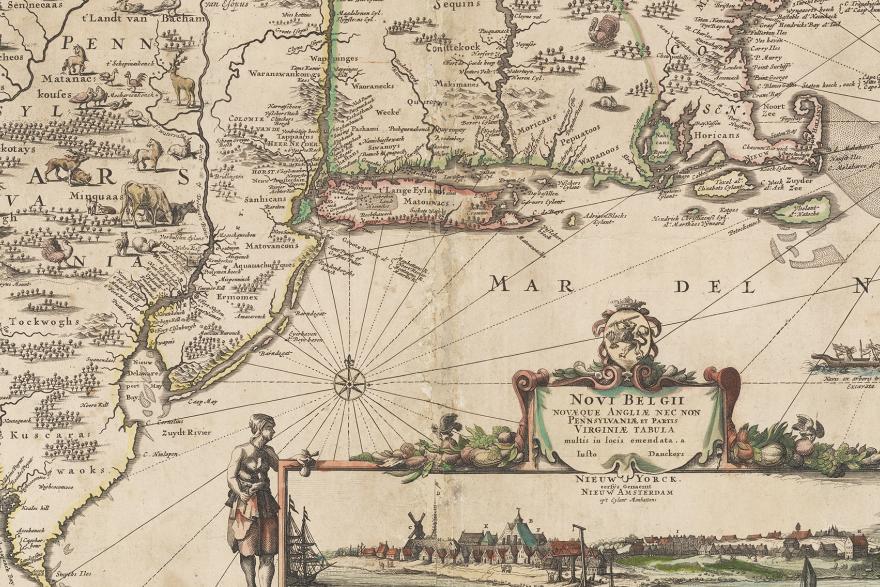
Image: Novi Belgii [The Danckers map and view.], Justus Dankerts (1635-1701), ca. 1682. Museum of the City of New York, 29.100.2205.