Press Release: The City Electric
Museum of the City of New York to Present The City Electric: New York’s Gilded Age
Exhibition pairs the Museum’s renowned collection of Gilded Age fashion, jewelry, and decorative arts with the story of a city remade by wealth, immigration, migration, and invention
Press Preview: Tuesday, March 9, 2027 | Public Opening: Friday, March 12, 2027
Contact: PressOffice@mcny.org | 917.492.3482
NEW YORK, NY (October 28, 2026) — The Museum of the City of New York will present The City Electric: New York’s Gilded Age, on view from March 12 through October 11, 2027. The exhibition takes visitors inside the mansions, wardrobes, and social rituals of gilded New York, then steps outside into a city where record immigration, Black migration from the South, and a booming industrial economy were remaking New York at the same moment its wealthiest families were building palaces on Fifth Avenue.
“The Gilded Age made New York a world capital, and it did so on the strength of its people, from the mansions of Fifth Avenue to the tenements of the Lower East Side and the parlors of central Brooklyn,” said Stephanie Hill Wilchfort, Ronay Menschel Director and President of the Museum of the City of New York. "The City Electric places those lives side by side, revealing a metropolis remade by newcomers and bold ideas on its way to becoming the iconic city we know today.”
As the show explores, New York’s dynamism ran far deeper than its gilded image. A historic wave of immigration reshaped the city’s streets, industries, and culture. Across the East River, Black Brooklynites forged a community of lasting social and political influence. And as townhouses rose and tenements teemed, the Brooklyn Bridge linked New York and Brooklyn, pointing the way toward a new urban colossus.
"Known for glitter and gold, the Gilded Age is also New York’s coming-of-age story, the moment of emergence for both a class of international tastemakers and a striving population ready to assert the city’s status for the American century," said Lilly Tuttle, the Museum's Senior Curator of the Collection, who organized the exhibition.
The City Electric: New York's Gilded Age is made possible by our advocate, Margaret Stearns Fund for Decorative Arts. Thank you to our sponsors, The David Berg Foundation and Todd DeGarmo | STUDIOS Architecture, and our friend, Silver Huntington Fund. Support for curatorial and collections work on this exhibition is provided by the Laura and Ray Johnson Fund.
A new edition of the Museum’s book Gilded New York: Design, Fashion, and Society (Monacelli) accompanies the exhibition.
Inside The City Electric
On view in the Museum’s James G. Dinan and Elizabeth R. Miller Gallery, the exhibition opens with portraits of Virginia Michaels Stern (Mrs. Isaac Stern), Louisa Van Rensselaer Baylies (Mrs. Edmund Lincoln Baylies), and Sarah Schermerhorn.
Tiffany & Co. seed pearls and Montana sapphires, imported Parisian fans, and classically inspired micro mosaics appear beside the artifacts of social competition: an invitation to Caroline Astor’s exclusive Patriarchs Ball, opera glasses monogrammed for Florence Shloss Guggenheim, and a booklet locket marking the 1899 marriage of Cora Guggenheim and Louis F. Rothschild.
On view among looks worn through as many as six wardrobe changes a day are a wedding dress by Irish-born dressmaker Catherine Donovan and a suit belonging to railroad tycoon Jay Gould. One of the exhibition’s signature gowns is the “Electric Light” costume Alice Claypool Vanderbilt wore to William K. and Alva Vanderbilt’s 1883 housewarming ball, covered in lightning bolts celebrating a new technology.
Another section reveals the corsets, bustles, and chemises beneath, through a monogrammed 1901 trousseau, an open bodice worn by Helen Miller Day Gould, and John D. Rockefeller’s dresser set.
Visitors will encounter furnishings from the cosmopolitan “American Renaissance” that filled Fifth Avenue's mansions. They include a table by the Herter Brothers, who decorated William H. Vanderbilt’s “triple palace”; a stained glass window Richard Morris Hunt designed for financier Henry G. Marquand’s East 68th Street mansion; Leon Marcotte chairs from a Brooklyn Heights home that won first prize at the 1876 Centennial Exposition; a gold cup and platter gifted by J.P. Morgan; a piano from the Waldorf-Astoria’s “Peacock Alley”; and a maid’s uniform recalling the Irish women who made up most of the city’s domestic workforce.
Photographs and personal objects in the galleries document the new arrivals who, a few miles downtown, transformed the city’s neighborhoods and labor force. Images by Jacob Riis, Alice Austen, the Byron Company, Augustus Frederick Sherman, and Lewis Hine appear alongside baby shoes worn by the son of an Irish chambermaid, born in a Third Avenue tenement in 1908; visitors will encounter Purim molds a Jewish family carried from Odessa in 1907 and a maquette by the Piccirilli brothers, the Italian stone carvers behind the New York Public Library lions and Central Park’s Maine Monument.
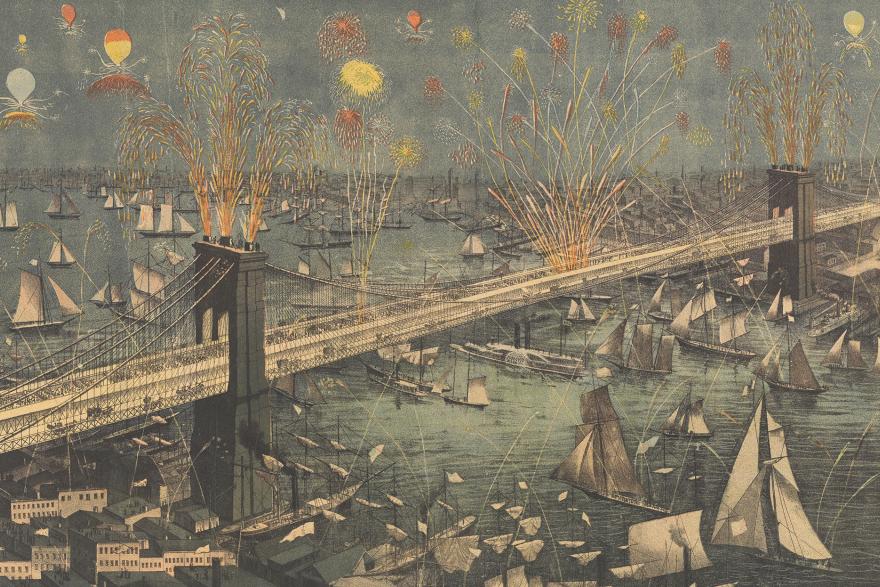
Early films by Thomas Edison and the American Mutoscope and Biograph Company, screening in the exhibition, capture a city in motion and newly electrified, typified by the Brooklyn Bridge, the era’s most ambitious feat of engineering, which opened on May 24, 1883, and set the stage for the consolidation of Greater New York in 1898. Emily Warren Roebling, who oversaw the completion of the Brooklyn Bridge, appears in an iconic portrait by Carolus-Duran on loan from the Brooklyn Museum.
The exhibition spotlights the society that Black New Yorkers in Central Brooklyn built decades before the Harlem Renaissance, parallel to Manhattan’s, with debutante parties, club receptions, and summers in Newport. It follows one extended family, including pharmacist and Brooklyn Board of Education member Philip A. White and New York Age editor Jerome Bowers Peterson.
Visitors will read excerpts of works by the Innocents, a circle of poets that included T. Thomas Fortune and inventor Lewis Latimer and writing by the founders of the Women’s Loyal Union, formed after Ida B. Wells addressed a New York audience in 1892. Among the highlights is a reproduction of Wells’s pamphlet Southern Horrors, funded by that event.
“Walk through The City Electric and you’ll meet a railroad tycoon, an Irish chambermaid, and a Brooklyn pharmacist who sat on the Board of Education, all living within a few neighborhoods of one another,” said Elisabeth Sherman, the Museum's Robert A. and Elizabeth Rohn Jeffe Chief Curator and Deputy Director. “Meeting all of these historic figures gives us a richer sense of the complexity and vibrancy of New York in this era.”
A Museum Collection Enters Its Second Century
By 1923, New York had emerged from the Gilded Age as a modern metropolis, and the way of life that defined the era was passing. The Museum of the City of New York, founded that year, became an early beneficiary of the objects that era left behind, including many on view in the exhibition. The origins of its 750,000-object collection remain bound up in the period.
Gilded New York Returns in a New Edition
The City Electric is accompanied by a new edition of Gilded New York: Design, Fashion, and Society (Monacelli), publishing March 12, 2027. A sold-out best-seller, first published in 2013 alongside the Museum’s exhibition Gilded New York, the volume, edited by Donald Albrecht and Jeannine Falino, now includes a new essay by Dr. Lilly Tuttle, “Beyond the Ballroom: New York’s Transformation in the Gilded Age,” and a foreword by Stephanie Hill Wilchfort. Review copies will be available to press in February.
About the Museum of the City of New York
The Museum of the City of New York explores the people, places, and ideas that shape New York’s iconic character. We invite New Yorkers and visitors alike to discover their place in the city’s evolving story.
The Museum is located at 1220 Fifth Avenue. Public hours are Monday–Friday, 10:00 a.m.–5:00 p.m., and Saturday and Sunday, 10:00 a.m.–6:00 p.m. The Museum is pay-what-you-wish for New Yorkers and free to those under 18. On Wednesdays, the Museum is free to all visitors and open until 9:00 p.m.
Featured Image: Bird's-Eye View of the Great New York and Brooklyn Bridge and Grand Display of Fireworks on the Opening Night (detail), A. Major, 1883, Museum of the City of New York, 29.100.1752